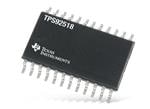

TPS92518PWPR

Texas Instruments
595-TPS92518PWPR
TPS92518PWPR

Fabricante:

Descripción:
IC de controladores de iluminación LED 42-V Dual buck LED c ontroller with SPI A 595-TPS92518PWPT

Modelo ECAD:
Descargue Library Loader gratis para convertir este archivo para su herramienta ECAD. Conozca más sobre el modelo ECAD.

En existencias: 1.285

Existencias:
1.285 Se puede enviar inmediatamente
Plazo de entrega de fábrica:
18 Semanas Tiempo estimado de producción de fábrica para cantidades superiores a las que se muestran.
Mínimo: 1   Múltiples: 1
Precio unitario:
$-
Precio ext.:
$-
Est. Tarifa:
Empaque:
Envase tipo carrete completo (pedir en múltiplos de 2000)

Precio (CLP)

Cantidad Precio unitario
Precio ext.
Cinta cortada / MouseReel™
$3.151 $3.151
$2.866 $28.660
$2.678 $66.950
Envase tipo carrete completo (pedir en múltiplos de 2000)
$1.585 $3.170.000
$1.546 $6.184.000
† $5.000 Se agregará y calculará la tarifa de MouseReel™ en su carrito de compras. Ningún artículo de MouseReel™ se puede cancelar ni devolver.

Embalaje alternativo

N.º de artículo del Fabricante:
Embalaje:
Reel, Cut Tape, MouseReel
Disponibilidad:
En existencias
Precio:
$3.496
Mín.:
1

Producto similar

Texas Instruments TPS92518PWPT
Texas Instruments
IC de controladores de iluminación LED 42-V Dual buck LED c ontroller with SPI A 595-TPS92518PWPR

Atributo del producto Valor de atributo Seleccionar atributo
Texas Instruments
Categoría de producto: IC de controladores de iluminación LED
RoHS:  
2 Output
Buck
5 A
HTSSOP-24
42 V
6.5 V
1 kHz to 2 MHz
Adjustable
TPS92518
- 40 C
+ 125 C
Brightness Control/Dimming, High Output Accuracy, Thermal Shutdown
Reel
Cut Tape
MouseReel
Marca: Texas Instruments
Kit de desarrollo: TPS92518EVM-878
Reducción de luminosidad: Analog, PWM
Voltaje de entrada: 6.5 V to 42 V
Sensibles a la humedad: Yes
Estilo de montaje: SMD/SMT
Número de canales: 2 Channel
Producto: LED Controllers
Tipo de producto: LED Lighting Drivers
Cantidad de empaque de fábrica: 2000
Subcategoría: Driver ICs
Corriente de suministro - Máx.: 4 mA
Tipo: Dual Channel Buck LED Controller
Peso de la unidad: 154,500 mg
Productos encontrados:
Para mostrar productos similares, seleccione al menos una casilla de verificación
Seleccione al menos una de las casillas de verificación anteriores para mostrar productos similares en esta categoría.
Atributos seleccionados: 0

Esta funcionalidad requiere que JavaScript esté habilitado.

CNHTS:
8542399000
CAHTS:
8542390000
USHTS:
8542390090
TARIC:
8542399000
MXHTS:
8542399901
ECCN:
EAR99

IS32LT3175N/P Single-Channel Linear LED Drivers

ISSI IS32LT3175N/P Single-Channel Linear LED Drivers come with fade in/out and PWM dimming. The regulators serve as a stand-alone LED driver-configurable from 20mA to 150mA with external resistors, no microcontroller is necessary. A logic level “courtesy light” signal from the PWM pin can be interfaced to precisely drive the LED channel. The IS32LT3175P obtains a positive polarity PWM signal. In addition, the IS32LT3175N obtains a negative polarity PWM signal. The regulator integrates a 63-step fade-in and fades out the algorithm (Gamma correction). This causes the output LED current to increasingly rise up to the full source value after the EN pin is pulsed.

TPS92518 Dual Buck LED Controllers

Texas Instruments TPS92518 Dual Buck LED Controllers are dual-channel buck LED current controllers with an SPI communications interface. The serial communication interface provides a singular communication path for multichannel and platform lighting driver module (LDM) applications. The Texas Instruments TPS92518 uses a quasi-hysteretic control method that supports switching frequencies ranging from 1kHz to 2MHz. This control method enables superior, high-frequency shunt FET dimming and handles the demanding dynamic loads of adaptive LED matrix-based headlamp systems. Software programmable SPI set points (Precision Peak Current, Controlled Off-Time, and Output Voltage Sense) enable designers to develop a single LED driver solution for multiple load configurations. These solutions can be quickly reconfigured for future LED driver design requirements.